“The essential American soul is hard, isolate, stoic, and a killer. It has never melted.”
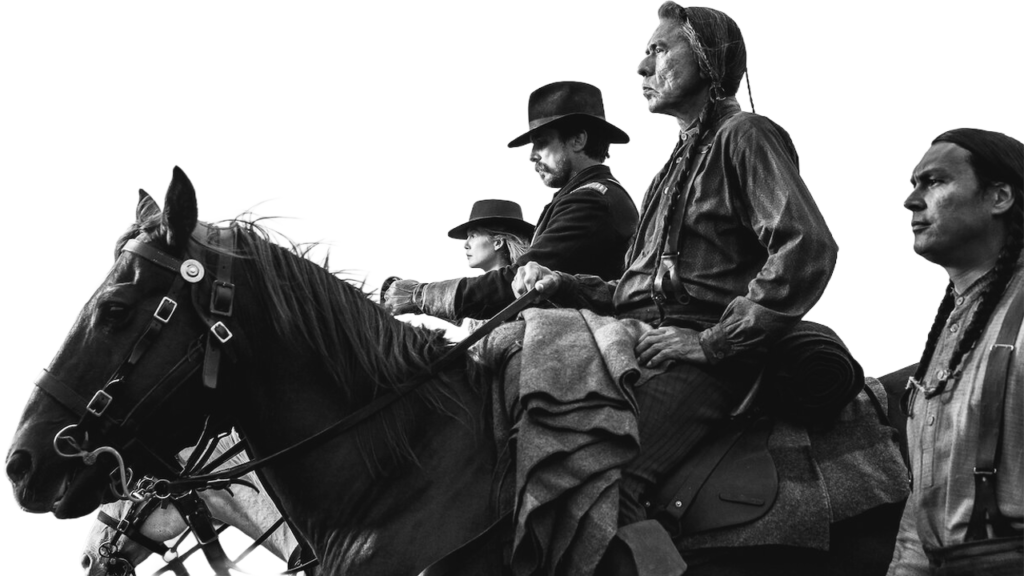
The film opens with this D. H. Lawrence quote, and the impression from the jump is that writer/director Scott Cooper channels his personal shame (and American guilt) on the mistreatment of the American indigenous into a moving film. “Hostiles” is a commentary on the energy behind white greed and white revenge resulting in permanent damage to the original Americans. It’s Bale as the American Union Soldier, the great elementary-school depiction of “the good guy”, with which the parasitic prejudice is meant to represent much more than just one soldier, as even the term “Hostile” is used to describe the indigenous. Cooper aims the film’s emotional weight at every American descended from elsewhere, and at moments it connects. I think he hopes that pathos outlives the runtime — sending viewers to study Native American history, or to support Native communities politically and economically today.
This modern Western opens with the gruesome destruction of Rosamund Pike’s family by Comanche assassins, sustaining the Western theme that the landscape is not capable of supporting the domestic life. This is the Wild West, and Cooper clearly pays homage to a very similar scene where the audience first meets Henry Fonda in Leone’s “Once Upon A Time In the West” which echoes the same message. The world the audience is presented with is dangerous, and threats can emerge at any time.
Adding on to this is the common theme of the soldier’s limited engagement with God, as it is always Pike’s character, the one that comes from the domestic space, that conveys Christian thought. There is too much violence and instability for God to be someone or something looking after those who live there. To Cooper, the American West is Godless. Death after death after death claims the characters we meet along the way, and I read it as Cooper emphasizing how trauma becomes a constant weight for oppressed people. Injustice turns into routine, and the discomfort comes from how ordinary it feels.
Christian Bale’s Capitan Blocker is fully cognizant of this dangerous world, and he is tasked with returning a Cheyenne family back to their ancestral lands in Montana. Blocker initially refuses due to previous conflict with the Cheyenne in war, and it is apparent this prejudice stems beyond this specific Cheyenne family. Hardened by trauma, predisposition, or a combination of both, Blocker is regularly met with resistance over his opinions. What really causes an audience’s ears to perk up is how Cooper sprinkles anecdotes from various characters of Blocker’s presence at the Wounded Knee Massacre. We know he was there… not much regarding his involvement in it. The film ends with Bale asking himself, “How can I be a good man from now in the face of my past”?
Unfortunately, it suffers from swaying into the guise of the melodramatic, teasing viewers with quick moments that can be cringe-inducing. Cooper leans on more than one sequence of Rosamund Pike and Christian Bale screaming in front of a handheld camera, the sound muted in favor of the non-diegetic score. It’s supposed to look powerful. It ends up feeling hollow.
Nevertheless… worth the watch. 4 stars.