
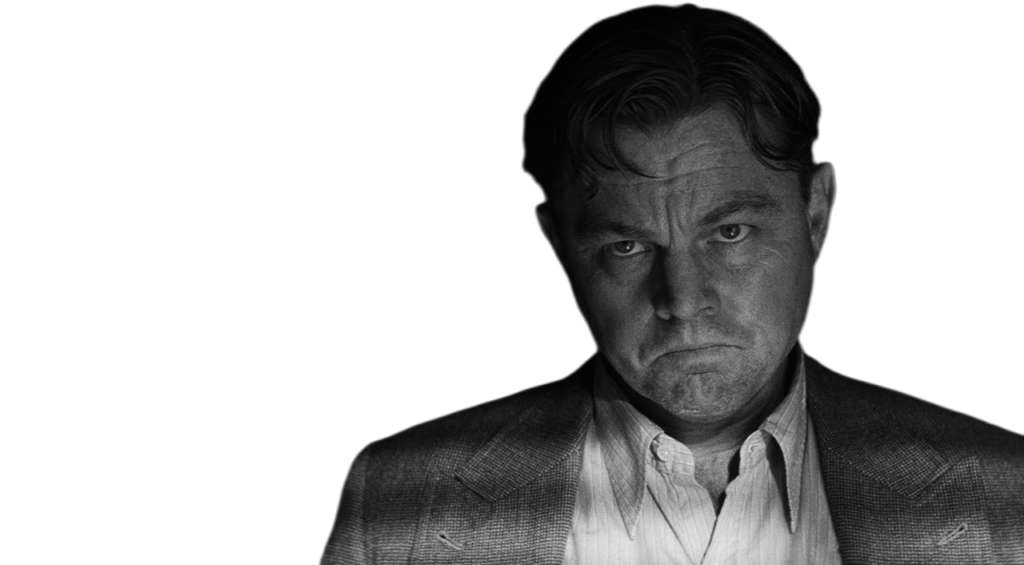
This review may contain spoilers.
“The most personal is the most creative.” This film school 101 Martin Scorsese quote (which got even more popular when director Bong Joon Ho shouted it out during an Oscar winning acceptance speech) was the biggest question I had for what Scorsese was cooking up with his 2023 period epic. What did Marty have up his sleeve for a movie about the Osage people of Oklahoma? Why would he want to tell this story?
It only took a few minutes to realize his obvious thumbprint. Coupled with its lengthy runtime, the amount of death and pain in the film becomes exhausting. The incessant tragic arc is fully plucked from the gangster tropes (which Scorsese helped establish) and placed into this film. “Killers” has the feel of a gangster flick, taking us into a world where crime sends a message, where those with social power are tangentially linked to those who commit violent crimes to maintain the status quo. The point is… on Osage land, the status quo for what Americans know about the historical treatment of indigenous peoples is flipped upside down. The Osage in the 20s have the most GDP per capita out of anyone else in the world, and “Killers” is utterly self-aware it needs to place itself as a quasi-history lesson for non-Osage audiences. When Ernest Burkhart (Leo DiCaprio) first makes his way to his uncle’s estate, he is told by an Osage man as he drives Ernest, “This is my land.” Scorsese then cranes upward, showing the vast landscape of oil derricks. In Oklahoma, Ernest is going to have to get used to this. The Osage tradeoff for assimilation into American culture (the first shot was the burial of a peace pipe, a mourning for dying elders and thus knowledge of the Osage way of life) is economic prosperity. It is not expected that we know much about the Osage at that time.
While yes a history lesson, once we get a chance to meet William “King” Hale (Robert De Niro)… we have a feeling of what will be coming in the 3 hours ahead. Hale sees the American white populations rise as the natural order of things, a tsunami wave of a Manifest Destiny that will eventually plague the Osage at some point. The status quo may not be the oppression of their people, but his status quo is the eventuality of it. You get the sense Hale is thinking… If the supremacy of the white race is bound to naturally prove itself, why don’t I swim with the current and see what it can do for me? It is why he suggests Ernest marry Mollie (Lily Gladstone, who literally out-acted freaking Leonardo DiCaprio and Robert De Niro in this movie) so that he can hold Ernest’s hand the entire time on the journey. It is a credit to De Niro for bringing so much to this character, because I genuinely think he seems himself as a good person simply more hyper-aware than others, no matter how twisted or deep prejudice runs in his psyche.
With all that, easily the most interesting character in “Killers” is Ernest, who is immediately established as both consistently ferdutzt and a man so gullible, he would actually jump off a cliff if you told him to. And here is where I can begin to scratch the surface over the scope this film shoots for… something quite big. I think most impressive about what Scorsese crafts here is a story that really IS about America. In what other country could a husband and his uncle poison his wife and kill her entire bloodline for oil money? It is a rough and honest look in the mirror, and the astonishing part is that it centers around three people who 99.9 percent of the audience have never heard of before watching this, as if this story doesn’t even come CLOSE to qualifying for being vile enough to be mentioned in a history textbook. Again, it’s where “Killers” knows it has to be a quasi-history lesson that only bolsters how the film is much larger, grander, more impactful than its already large 210 minutes.
Ernest and William resemble two portraits of the dark truth of the American conscience. Number One. The silent yet complicit [Ernest]. Number Two. The advantageous, who uses the absence of oppression to profit from the oppressed [King].
Number One [Ernest]: To dive deeper, I am going to turn to Richard Brody in his New Yorker review, who put it better than I ever could. “With his gee-willikers charm comes a kind of puerile—no, infantile—ignorance. Ernest is perfectly innocent and perfectly guilty, simple enough to know he’s doing wrong and unreflective enough not to doubt it’s the right thing to do. He isn’t so much a Jamesian central consciousness as he is a central block of unconsciousness, without a shred of insight; he’s a figure of naïve American contradiction whose sole glimmer of redemption is his love for Mollie, in his recognition of her nobility of character. (‘She’s a lady’ is the way he puts it.) The movie largely follows Ernest, and thereby calls viewers into complicity with his stunted and benighted perspective, denying them a way out of their own association with the system of depravity that sucks him in.” Ernest is the one who believes that if he closes his eyes, he is relieved of any and all responsibility to the tragedies at hand. He didn’t do any of it himself! How can they point the finger at him!
All roads lead to the penultimate scene in the film, which I also believe to be the best. After the trial, Mollie and Ernest sit down and she asks him the simple question, “What did you give me?” and he answers “Insulin”. The film never makes it objectively clear whether Ernest knows that Mollie’s medicine is actually poison, and Ernest really might be gullible enough to know he is poisoning her, even though the audience can put 2 + 2 together. And at least for me… I was still thinking But what if he really didn’t know? Didn’t he love her? Wasn’t he truly upset and surprised by the death of many in Mollie’s family? That’s the point.
When he tells her he gave her insulin, whether he genuinely didn’t know or did the poisoning himself, the result is the same. If he was too gullible to know or too cowardly to stop it, Scorsese purposefully leaves both options open to illustrate the point… it doesn’t matter. Whether there was outward prejudice or an inward silence, the native people still suffer from the action or inaction. Ernest is complicit and despite the potential for debate over Kantian ethics amongst audience goers after the film, Scorsese gives complicity and prejudiced action similar weight.
Number Two [William]: This one has a few less layers, but still depicts the figure looking to extort for personal progress, as David Ehrlich makes clear in his IndieWire review, “Hale kills the Osage with the indifference of a tiger mauling its prey.” Hale is a hunter, a predator, a hustler, looking to do whatever he can to protect and promote himself. Straight out of something from a gangster film.
I think the final impressive feat of “Killers” is its ability to avoid the banality of depicting racism in a period piece. Audiences for years have been hit on the head by the one-dimensional theme of: In the past… the whites were super racist… let’s make sure we are ALL on the same page… that it was really bad. Richard Brody credits the silence in the film for its eventual capability to expand its thematic scope and complexity beyond what is oftentime seen. He writes, “Nonetheless, the movie pivots on one of the great wordless gestures in recent movies—indeed, silence both runs through the action like a poison and serves as its own antidote. There’s a way of looking at this movie, a colossal tale of the sociopathy of American history, that’s a matter of listening to what’s said and what isn’t.”
The silence in the film, channeled through an unreflective Ernest, represents the routine complicity this country has shown toward injustice against Indigenous people. Regardless of the knowing of exact details, everyone in Oklahoma that wasn’t Osage knew what William was up to. The film is attempting to break the belief that there is an esotericism to explicit injustice or detached responsibility for those who do not engage in explicit injustice. But how do we make this personal? What is the first step for the audience? What can I do to be better? Scorsese closes his eyes. “The most personal is the most creative.” He turns to Catholicism, something most personal for him.
I promise, I’m not pulling a rabbit out of a hat here. With Scorsese, everything can be (and is) biblical. He’s admitted openly many times that before his eventual career in filmmaking, Scorsese was interested in a life of ministry, and the argument can be made that he frames the three central characters straight out of scripture. There is Mollie, the Jesus figure, who suffers and eventually dies from the sins committed on the Osage and her family. Ernest, the Judas figure, who directly contributes to Mollie’s agony despite his ability to stop it. William, the Devil.
That scene I mentioned earlier, where Ernest tells Mollie he gave her insulin and she leaves the room, plays out as a confession scene, a chance for Ernest to repent for his sins to the woman who suffered on his behalf. William is a consistent foil to Ernest, and when compared to the absolute monster William shows himself to be, I felt a tiny amount of compassion for Ernest, even though he fully walked himself into this situation. Really, his intentions were never as vile as William’s. Despite his complicity, Mollie gives Ernest the chance to redeem himself, and we watch him slam the door on himself. With William and Ernest as two central characters, Scorsese KNOWS audiences subconsciously compare. He turns to Ernest’s lack of religious virtue to make it clear how we must think of him leaving the theater.
But the Catholic tropes don’t end alongside the story. In “Killers”, we get an extended epilogue that emulates a true crime radio show from the 50s. After the 3+ hours of trauma just witnessed, the story is packaged, wrapped, and delivered to audiences decades later. And what’s the difference between this radio show and 200 million dollar movie directed by Martin Scorsese starring the world famous Leonardo DiCaprio? The answer? Not Much.
The ending is part repentance by Scorsese himself, apologizing to us that this story comes to audiences via red carpets, champagne flutes, and tuxedos rather than in a history class at school. His get-out-of-jail-free card is the sheer admission that this story cannot be the most personal to someone who looks like him, but that he is giving it his best shot. I think he sees portions of Ernest in his past self, and there is a shame there, a sin there. Moments where he was silent or naive in ways he didn’t have to be. It’s a first example of personal contemplation begs the audience to the same, and is likely why Scorsese wanted to make the film in the first place.
And beyond this film, taking sagas from real events filled with crime (whether it be “Killers” or his gangster films) is inherently Scorsese. His movies are known for their violence and cold-hearted characters. It is almost as if he is using the finale of “Killers” as a platform to ask forgiveness for the sin of doing this his entire career. Taking all the death and real pain people experienced and packaging up as viewable fine-dining for cinephiles. He knows he doesn’t have many more chances to make new features, and doesn’t have many more chances to share his psyche. Here, he gets the final word, a confession with tears in his eyes. It’s also here, where after 3 plus hours of taking in his work, it’s our obligation to reflect and confess. A story of America, made by an American legend.

The Forbidden Room: Can A Deranged Film Still Be Hilarious Amid Its Own Nonsense? (A Review)
This was my first Guy Maddin film, and regardless of the mixed feelings after watching The Forbidden Room, this won’t be my last. This 2015 Canadian low-budget experiment is amorphous, a string of short stories, in which the next one...
Read More
The Invite: I Hope My Dinner Parties Don’t Look Like This When I’m Older (A Review)
Joe and Angela are married. Joe (Seth Rogen) is a music teacher, eager to get a head start on his lengthy bicycle commute home, telling his orchestra to “practice a few more times” on his way out. Angela (Olivia Wilde)...
Read More
Lawrence of Arabia: An Epic That Justifies It’s Runtime with It’s Commentary
It’s been a couple of months since I got a chance to watch this in one sitting, and it still resonates on a near-daily basis. Probably my favorite “character study,” or at least showcase of a character who is never...
Read More
Scorsese Finding His Most Creative in “Killers of the Flower Moon”
This review may contain spoilers. “The most personal is the most creative.” This film school 101 Martin Scorsese quote (which got even more popular when director Bong Joon Ho shouted it out during an Oscar winning acceptance speech) was the...
Read More