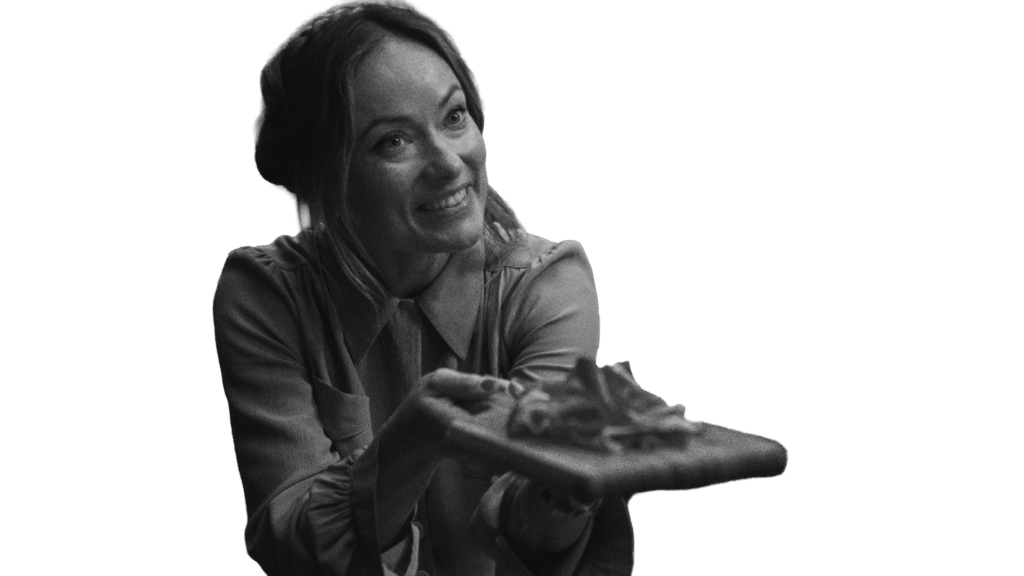
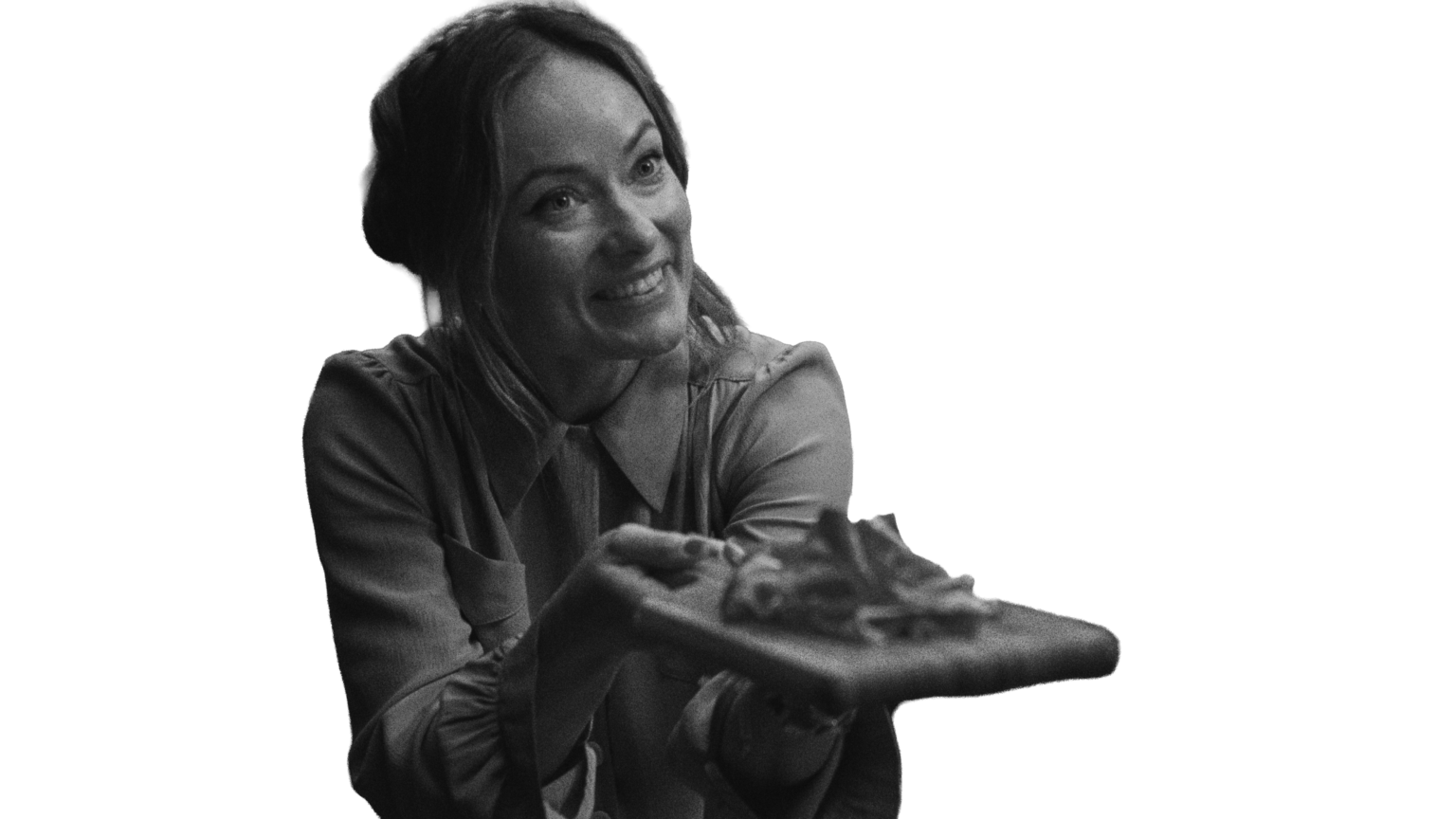
Joe and Angela are married. Joe (Seth Rogen) is a music teacher, eager to get a head start on his lengthy bicycle commute home, telling his orchestra to “practice a few more times” on his way out. Angela (Olivia Wilde) is a stay-at-home-mom (and we learn later, also an art school grad) effervescently arranging their San Francisco home to host another couple for dinner. On his commute, Joe squeezes into the rush hour BART and pedals up giant SF hills on his puny bicycle, literally collapsing on the floor in relief once home… until Angela requests he get ready for the dinner party.
Adamant there was no apprisal from his wife, Joe and Angela begin to argue, especially when Joe learns the guests are actually their upstairs neighbors— the same ones he detests for making a whole lotta noise in the middle of the night. With the energy askew, Angela asks Joe for a “reset”. It’s a technique where Joe actually leaves and re-enters their home, giving both a second chance at the conversation by acting like the last few minutes never happened.
In many ways, this “reset” can serve as a metaphor for Olivia Wilde’s own filmmaking career. Following the thematic and PR flops of 2022’s big-studio Don’t Worry Darling, Wilde punches back by crafting a cringe comedy that feels like a filmmaker looking to master the basics. Like a delicious dish with only a few ingredients, The Invite excels by delighting us with something that is tight but sharp, exemplifying how limitations can augment creativity.
Right when Joe and Angela’s argument peaks, the neighbors are at the door. Hawk and Pina walk in (Edward Norton and Penelope Cruz) and Hawk admits they heard the argument from outside, looking to be reassured that this is still “a good time” for their dinner party. Angela tries to downplay it as Joe rudely introduces himself precisely a full room away from the guests. Things were already starting to feel prickly, but it’s with Hawk’s immediate display of transparency that we can sense it’s just a matter of time before things go sideways.
Rogen and Wilde initially set a pace with their banter, where the back and forth is so normal that we instantly understand this to be their status quo. Joe is a bit of a curmudgeon, ready to speak what he’s thinking to protect himself and show he’s uninterested in any sort of smarmy performance for his neighbors. Due to his attitude, Rogen delivers many of his jokes like throwaways, even though they pierce like one-liners.
Angela is desperate to portray herself and Joe as hospitable, and Wilde plays up her facial expressions in an effort to curb Joe. Here, it totally works for a character exhausted by their husband’s unbridled comments, yet so jittery that a missing wine opener feels like the night’s already doomed.
Hawk and Pina come across as confident in themselves, stable from some sort of introspection that probably drew them to each other. Both Norton and Cruz have separate moments late in the film where they get to take the reins, and both round the story with depth when it needs it. Despite the script subtly mocking each character, its Cruz’s Pina who serves as our voice of reason through parts of it. Cruz’s ability to project a fearlessness means that Pina is often the only one capable of seeing anything in the big picture.
A movie like this can only survive with good actors. Funny actors. All four of them succeed by knowing who their characters are, meaning that when they clash, we notice the humor between their differences.
Besides the performances, The Invite is a great example of something bare bones, that still maximizes its filmmaking opportunity. With one location and a few actors, it makes sense that this was originally written as a play, yet Wilde finds a way for it to feel deeply cinematic. The score helps to build tension when needed; there are distinct examples of framing (sometimes with mirrors!) that depict characters either at odds or aligned; and it’s literally shot on 35 millimeter to give it a soft and textured “film” look.
I think I most appreciated the snappy editing, where a quick reaction can elicit a laugh, or a newly introduced angle signals to us a shift in a character’s perspective. The camera is always going back and forth between the four faces, and its flow is critical to preventing things from dragging when an entire movie takes place in one house. There are even moments where pairs of characters separate to different rooms, and the real-time intercutting adds the variety needed to avoid anything from getting boring. Rather than relying on wide, long takes in hopes the actors indulge in the dialogue-heavy scenes, it’s this intention and ultimate execution of speedy, refined editing —something that itself is uniquely cinematic— that helps elevate the film beyond what the script offers alone.
There are plenty of moments when Joe and Angela are pretty vicious to each other, and the film may polarize some audience members with how unlikable they may seem. Near the end, we get the background on the built-up resentment both of them carry about their lives… but we really only root for them because Seth Rogen and Olivia Wilde are legitimately funny. The film presents Joe and Angela as equally unstable in their own ways, but a deeper exploration of Joe’s relationship with his music or of Angela’s life after art school would allow us to empathize more easily when things swing sentimental.
Nevertheless, the film investigates truths that will resonate with a lot of viewers. It’s about a fractured couple incapable of talking through their feelings, ready to turn to literally anything else as a life raft. It capitalizes on the universal assumption that everyone else is doing “better” or “cooler” things than us and that emulation is a better response than introspection. Sometimes, a “dinner-party-gone-wrong” film aims to show a set of characters at odds, granting the audience an opportunity to pick a side. The Invite feels fresh because it doesn’t want to judge the characters for their intentions or desires; it just wants us to make fun of them.
4 out of 5 stars.